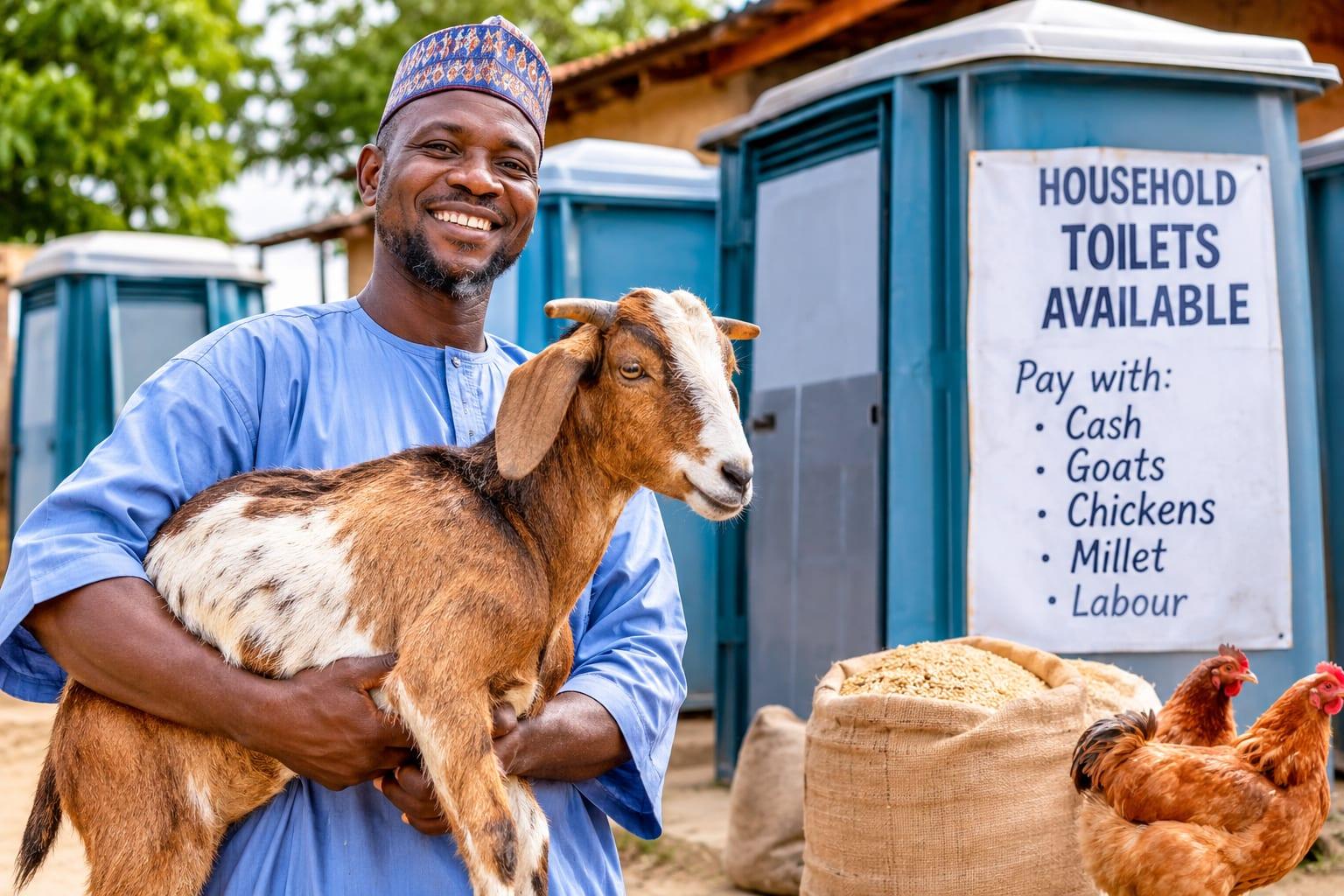
In Bauchi State, one entrepreneur is showing that getting paid doesn't always have to mean receiving cash. Sometimes, it means taking home a goat, a few chickens or bags of millet.
What would you do if a customer wanted to buy something from your business but couldn't afford to pay in cash?
Would you turn them away, offer a discount or find another way to make the exchange work?
For Ibrahim Kabo Umar, a sanitation entrepreneur in Bauchi State, the answer has been rather creative.
A Business Built Around a Community Need
Ibrahim's journey into the sanitation business began about a decade ago, when he opened a modest public toilet facility with 20 compartments at Railway Market in Bauchi.
Running the facility meant handling everything from maintenance to customer service, serving an average of 200 to 300 people every day.
But he saw an opportunity beyond the daily business. Access to clean, functional toilets was a necessity, and he believed proper sanitation could make a real difference in people's lives.
His business eventually grew.
After participating in toilet business training organised by UNICEF, the Bauchi State Government and LIXIL under the Make a Splash! project, Ibrahim gained new knowledge about sanitation technology, hygiene management and business development.
He expanded his operations, opened another public toilet facility and introduced additional services.
Eventually, he moved into household toilet sales, helping families bring proper sanitation into their homes.
There was, however, one challenge: not everyone who needed a toilet could afford to pay for one in cash.
And instead of letting that become a barrier, Ibrahim found another way forward.
When Trade By Barter Comes Into Play
Not every customer walks into Ibrahim's business with money in hand.
Some have farm produce. Others have livestock. Some could contribute their labour.
So, he introduced payment options that allowed people to access toilets using the resources available to them.
According to UNICEF's report, families could access these arrangements through:
- Cash: Conventional payment for households able to afford it.
- Trade by Barter: Exchanging agricultural produce such as millet, goats and chickens for household toilets.
- Labour: Helping with construction.
- Microfinance: Accessing loans with flexible repayment arrangements.
- Community support: Receiving assistance from community and religious leaders who sponsor toilets as an act of philanthropy.
Think about what this means.
A farmer who may not have enough cash to purchase a household toilet could have goats or millet that another person finds valuable. Rather than allowing the absence of money to end the conversation, both parties can explore an arrangement that works.
The customer gets something their household needs, while the business receives value in another form.
More Than a Business Transaction
Ibrahim's story goes beyond accepting farm produce and labour instead of money. It is also about making an essential service accessible to more people.
For families without proper household toilets, access to improved sanitation can have significant implications for health and hygiene.
UNICEF reports that these flexible payment options have helped more families own private, clean and functional toilets, reducing their reliance on open defecation.
Ibrahim's approach also reflects something important about entrepreneurship: having a product people need is only part of running a successful business. sometimes, solving a customer's problem requires looking beyond the conventional way of doing business.
A business can have a product people genuinely need, but if the payment arrangement makes that product inaccessible, an opportunity is being missed.
By recognizing that customers have different resources and finding alternative ways to exchange value, Ibrahim has created more room for people to participate.
He isn't simply asking what customers can pay. He's considering what they have to offer.
The Bigger Lesson: Value Goes Beyond Money.
We often associate payment with money. It's what businesses are used to and how most everyday transactions happen.
But Ibrahim's story challenges that way of thinking.
A goat has value. Agricultural produce has value. Labour, skills, time and services have value too.
The important thing is finding someone who needs what you have and is willing to offer something you need in return.
This is one reason barter remains relevant, even in a world where digital payments and bank transfers are part of everyday life. It provides another way for people to access goods and services when cash isn't readily available.
And the possibilities extend far beyond livestock and agricultural produce.
A graphic designer could exchange a design service for photography. A fashion designer could offer an outfit in return for a service they need. Someone with an unused appliance could find another person willing to exchange something of comparable value.
The items and services may differ, but the idea remains the same: both parties have something to offer, and both have something to gain.
What This Means for the TradebyBartr Community
At TradebyBartr, we believe that value goes beyond money.
Ibrahim's story is a practical example of what happens when people recognize value in different forms and explore alternative ways of exchanging it.
Just like TradebyBartr, his approach centers on a simple idea: using what you have to get what you need.
On TradebyBartr, you can list items or services you have, specify what you'd like in return, discover what others are offering and negotiate an exchange that works for both parties.
You don't need to own a business or have a special payment arrangement to take part. It could be a skill you've developed, an appliance you no longer use or a service you can provide.
You might be sitting on something someone else has been looking for.
Ibrahim Kabo Umar's story reminds us that sometimes, the biggest obstacle to getting what we need isn't the absence of value. It's failing to recognize the different forms that value can take.
You have something to offer. Someone else might have exactly what you need.
And that's where a good exchange begins.
Ready to find out what your next exchange could look like?
Join the TradebyBartr community. List what you have, discover what others need and find your next great exchange. Explore TradebyBarter
About the original story
Source: Inspired by a report originally published by UNICEF Nigeria, written by Anike Alli-Hakeem. Read the original story.